Building a daily reading routine for children is one of the simplest and most powerful things a parent can do for a primary school child. Just fifteen to twenty minutes of shared reading each day strengthens vocabulary, comprehension, and concentration — and, just as importantly, it teaches children that books are a pleasure rather than a chore. The good news is that a routine does not need to be perfect or complicated. It needs to be regular, relaxed, and enjoyable enough that your child asks for it.
Many parents worry they are starting too late or doing it wrong. In reality, children respond quickly once reading becomes a predictable part of the day, much like brushing teeth or having breakfast. This guide walks you through how to set up a reading routine that fits your family’s schedule, how to choose the right books, and how to keep the habit alive when motivation dips.
Why a Daily Reading Routine for Children Matters
Children who read every day encounter far more words than children who read only at school, and that exposure shows up in every subject — not just English. Regular reading builds background knowledge, improves spelling patterns, and helps children follow longer, more complex stories and instructions. It also supports emotional development: stories give children a safe way to explore feelings, friendships, and new situations.
A routine also removes the daily negotiation. When reading always happens at the same point in the day, it stops being an extra task and becomes part of family life. If your child finds learning difficult or becomes frustrated with schoolwork, the gentle, pressure-free pace of home reading can rebuild confidence; our guide on how parents can guide children through learning challenges with patience explores that supportive approach in more depth.
Choose a Time That Your Family Can Keep
The best time for reading is the time you can repeat every day. For many families that is just before bed, when the house is quieter and a story helps a child wind down. For others, ten minutes after breakfast or straight after school with a snack works better. Look at your real schedule rather than an ideal one, and attach reading to an event that already happens daily — after dinner, after bath time, or during the wait for a sibling’s activity to finish.
Start small. Ten minutes every day beats an hour once a week. Once the habit feels automatic, most children naturally ask to keep going, and you can stretch the session to twenty or thirty minutes. Keep books within easy reach of the chosen spot — a small basket by the sofa or a shelf beside the bed — so starting never requires a hunt.
Set Up a Cosy, Distraction-Free Reading Corner
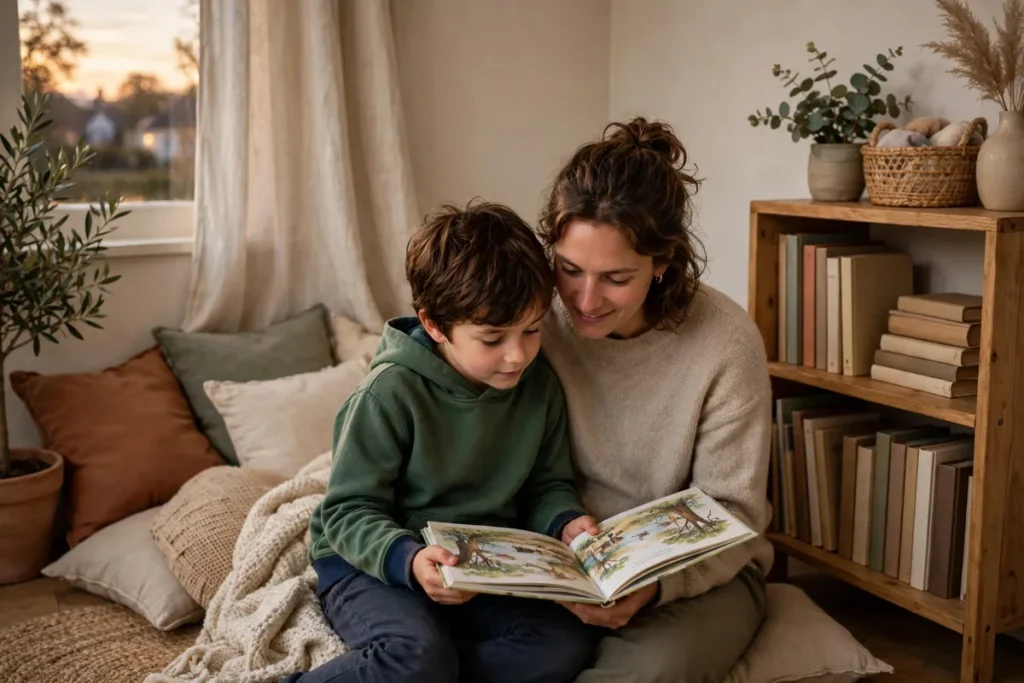
Children do not need a purpose-built library, but a consistent, comfortable place helps signal that reading time has begun. A corner with cushions, a beanbag, or simply the same end of the sofa works well. Keep screens off and phones in another room during the session; even a short, protected window of attention makes the experience feel special rather than rushed.
Let your child help create the space. Choosing a cushion, a small lamp, or a bookmark of their own gives them ownership of the routine. Younger children also enjoy a “reading buddy” — a favourite soft toy that listens to the story. These small rituals sound simple, but they turn reading into an event children look forward to, in the same way that the strategies in our article on encouraging positive behaviour in young children use routine and praise to build good habits.
Pick the Right Books: Choice Beats Level
Nothing kills a new routine faster than books a child finds boring or painfully difficult. Let your child choose most of what you read together, even if the choices seem repetitive or below their school reading level. Comics, joke books, football annuals, and non-fiction about animals or space all count as reading. A useful test for independent reading is the five-finger rule: if a child stumbles on more than five words on one page, the book is probably too hard for solo reading right now — but it may still be perfect for you to read aloud together.
Rotate the selection. Visit the library every couple of weeks if you can, swap books with friends, and mix familiar favourites with one new title. Non-fiction is especially good for reluctant readers because it connects to what already fascinates them; a child who loves experiments, for example, may race through a science book, just as hands-on activities work in engaging students with interactive experiments. As children grow more confident, carefully chosen apps can supplement paper books — our roundup of the best edtech apps for students includes reading-friendly options for older primary children.
Read Together, Talk Together
For younger primary children, read aloud and let them follow the words with their eyes. Pause to ask what they think will happen next, why a character acted a certain way, or what a new word might mean. These short conversations — sometimes called dialogic reading — build comprehension far more effectively than simply finishing the pages.
As your child becomes a more fluent reader, take turns reading a page or a paragraph each. If they get stuck on a word, give them a moment to try, then supply it calmly and move on; long corrections break the flow and the fun. Keep a relaxed eye on progress rather than testing them. The goal of the routine is a child who wants to read, because willing readers practise more, and practice is what produces skilled readers.
Keep the Routine Alive When Life Gets Busy
Every family misses days. The routine survives if a missed session is treated as normal rather than as a failure. On very busy days, shrink the session to five minutes or one short poem instead of skipping entirely — protecting the streak matters more than the length. Audiobooks in the car can also keep stories present on chaotic days, although they work best as a supplement to, not a replacement for, shared reading.
Finally, let your child see you read. Children copy what adults treat as normal and enjoyable. If they see you with a novel, a newspaper, or even a recipe book, the message is clear: reading is something people do for life, not just for school. Within a few weeks, a daily reading routine for children stops being something you organise and becomes something your family simply does — and the benefits keep compounding long after primary school.
Where to Take Your Child’s Reading Next
Once a daily reading routine is in place, small additions keep it fresh and challenging. Educational games can reinforce the same skills in a playful format — our beginner’s guide explains what gamification is and how it motivates young learners. For screen time that supports the routine rather than replacing it, browse our picks of the best EdTech apps for students and the best language learning apps if your child is starting a second language. Choosing that language matters too: our guide to the easiest language to learn helps families pick a realistic first option. Finally, remember that children copy what they see — the principles in our plan for self-directed learning for adults can help you build a reading habit of your own alongside theirs.