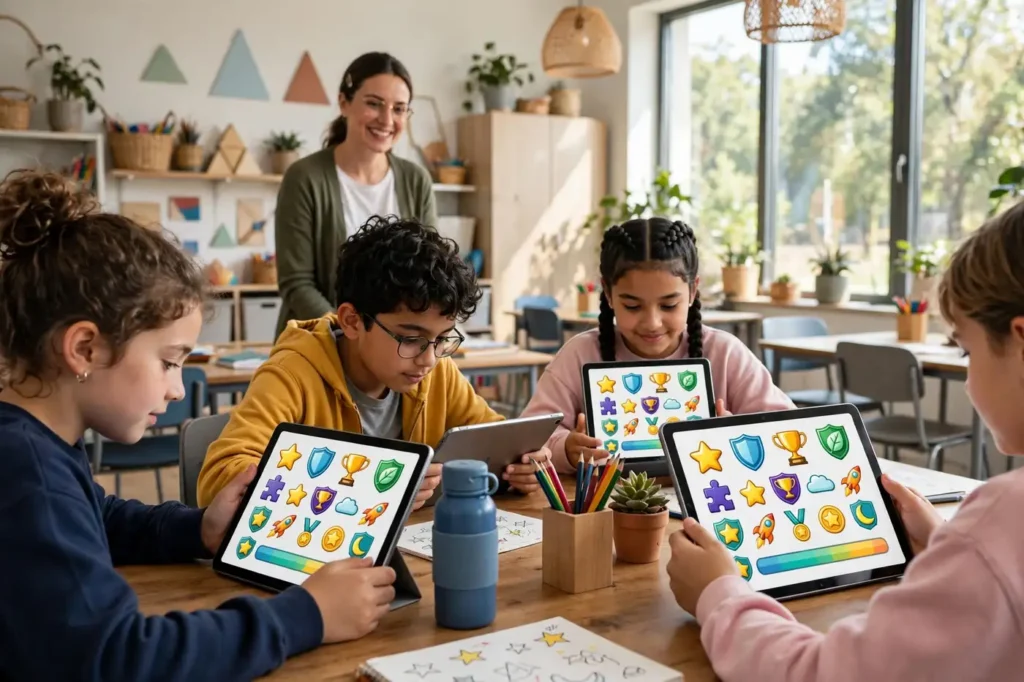
Gamification is the practice of adding game-like elements to activities that are not games. Points, badges, leaderboards, levels, challenges and streaks are the most familiar examples. When a language app awards you experience points for a lesson, when a fitness app celebrates a seven-day streak, or when a classroom quiz shows a live leaderboard, you are seeing gamification at work. The goal is simple: make an ordinary task more motivating, more engaging and easier to stick with.
The word itself is pronounced gay-mih-fih-KAY-shun. At its heart, the gamification meaning is about motivation, not entertainment. A well-designed gamified system does not turn your work into a video game. It borrows the feedback loops that make games compelling — clear goals, visible progress and immediate rewards — and applies them to learning, training, health and even marketing.
What Does Gamification Mean in Practice?
Think of a student working through an online course. Without any game elements, progress can feel invisible. The student finishes a module, and nothing happens. With gamification, the same student earns points for each completed lesson, unlocks a badge for finishing a unit, and watches a progress bar move toward the next level. The learning itself has not changed, but the experience around it has. That visible feedback is what keeps many learners going when motivation dips.
It helps to separate gamification from game-based learning. Game-based learning means using an actual game to teach something, such as a simulation that trains pilots or a board game that teaches economics. Gamification is different: the underlying activity stays the same, and game mechanics are layered on top of it. A quiz is still a quiz, but adding a timer, points and a leaderboard turns it into a gamified quiz. Understanding this distinction matters, because the two approaches are designed, measured and improved in different ways.
The Building Blocks of Gamification
Most gamified systems are built from a small set of mechanics. Points reward action. Every completed task earns a score, which gives learners a simple way to see how much they have done. Badges and achievements mark milestones, such as finishing a difficult module or helping a classmate. Leaderboards add a social layer by ranking participants, which can motivate competitive learners while giving everyone a benchmark.
Levels and progress bars show the journey. A beginner starts at level one and unlocks new content as they advance, which breaks a large goal into manageable steps. Challenges and quests give short-term missions with a clear finish line, such as completing five practice exercises before Friday. Streaks reward consistency by counting consecutive days of activity, which is why they are so effective for daily habits like vocabulary practice. Finally, immediate feedback ties everything together: the learner knows right away whether an answer was correct and what to do next.
None of these mechanics works on its own. Points without a meaningful goal feel empty, and a leaderboard without a way to improve feels unfair. The strongest systems connect every mechanic to a real learning outcome, so the reward always reflects genuine progress.
Gamification in Education
Education is where gamification has made the most visible difference. Language learning apps use streaks, experience points and leagues to keep learners returning daily, and gamification in education research and practice both point to the same lesson: engagement rises when progress is visible. Classroom tools take a similar approach, turning revision quizzes into live competitions where students answer under time pressure and see their rank after every question.
Online courses use progress bars, completion certificates and module badges to fight the most common problem in self-paced learning: dropout. When a course shows a learner exactly how far they have come and what remains, finishing feels achievable. Gamified learning tools work best when they give learners choice as well, such as letting students pick which challenge to attempt next or which skill path to follow.
Teachers also use gamification without any technology at all. A reading challenge with a wall chart, a class economy where good work earns classroom currency, or a team tournament for revision are all gamified systems. The medium does not matter nearly as much as the design: clear rules, fair rewards and feedback that helps the learner improve.
Gamification in Marketing and Everyday Life
Beyond the classroom, gamification shows up in many daily routines. Coffee shops stamp loyalty cards, airlines award miles, and fitness apps celebrate personal bests. In marketing, brands use points, tiers and challenges to reward repeat customers and encourage referrals. If you have ever wondered what is gamification in marketing, the answer is the same set of mechanics applied to customer behaviour: a loyalty programme is a gamified system where purchases earn points and points unlock rewards.
Workplace training uses gamification too. New employees complete onboarding quests, sales teams compete on leaderboards, and compliance courses award certificates for perfect scores. The pattern is consistent across fields: break a goal into steps, make progress visible, and reward the behaviours you want to see repeated.
Why Gamification Works
Gamification works because it supports three things people need to stay motivated. First, autonomy: learners feel in control when they can choose their next challenge or path. Second, mastery: points, levels and badges make improvement visible, which builds confidence. Third, purpose: a clear goal and a meaningful reward help learners understand why the task matters. How gamification is transforming online learning comes down to these principles applied consistently, not to any single trick.
Immediate feedback is the quiet hero of the whole system. In a traditional assignment, a student may wait days to learn how they did. In a gamified system, feedback arrives in seconds, which means mistakes can be corrected while the material is still fresh. Small, frequent wins also matter: finishing a five-minute exercise feels achievable, and a chain of small wins builds the momentum needed for larger goals.
Common Mistakes to Avoid
Gamification fails when it is treated as decoration. Adding points to a boring task does not make the task interesting; it only makes the points meaningless. A common mistake is rewarding quantity over quality, such as giving points for every page clicked rather than for genuine understanding. Another is overusing competition. Leaderboards motivate the top performers but can discourage everyone else, so good systems also celebrate personal bests, improvement and teamwork.
Rewards can also backfire if they replace intrinsic motivation. If students only work for badges, they may stop when the badges stop. The best gamified designs use rewards to draw learners in, then gradually shift the focus to the satisfaction of mastery itself. Finally, one-size-fits-all design rarely works: younger learners, adult professionals and casual app users respond to different mechanics, so the audience should shape the system.
How to Get Started With Gamification
If you are a teacher, start small. Pick one mechanic that fits a real goal, such as a progress tracker for a revision unit or team points for class participation. Explain the rules clearly, keep the rewards fair, and review whether the mechanic actually helped learning after a few weeks. Online learning platforms offer ready-made examples you can adapt, from badge systems to interactive quizzes.
If you are a learner, use gamification to support your own habits. Choose an app or system with streaks and visible progress, set a small daily goal, and protect the streak. Interactive tools can make practice feel less like a chore, and online learning communities add accountability, because studying alongside others makes it easier to stay consistent.
The simplest definition remains the best one: gamification means using game elements to make real tasks more motivating. Used thoughtfully, it turns invisible progress into visible achievement, and visible achievement into a habit. Whether you are teaching a class, training a team or learning a new skill yourself, that feedback loop is what makes the difference between starting something and finishing it.