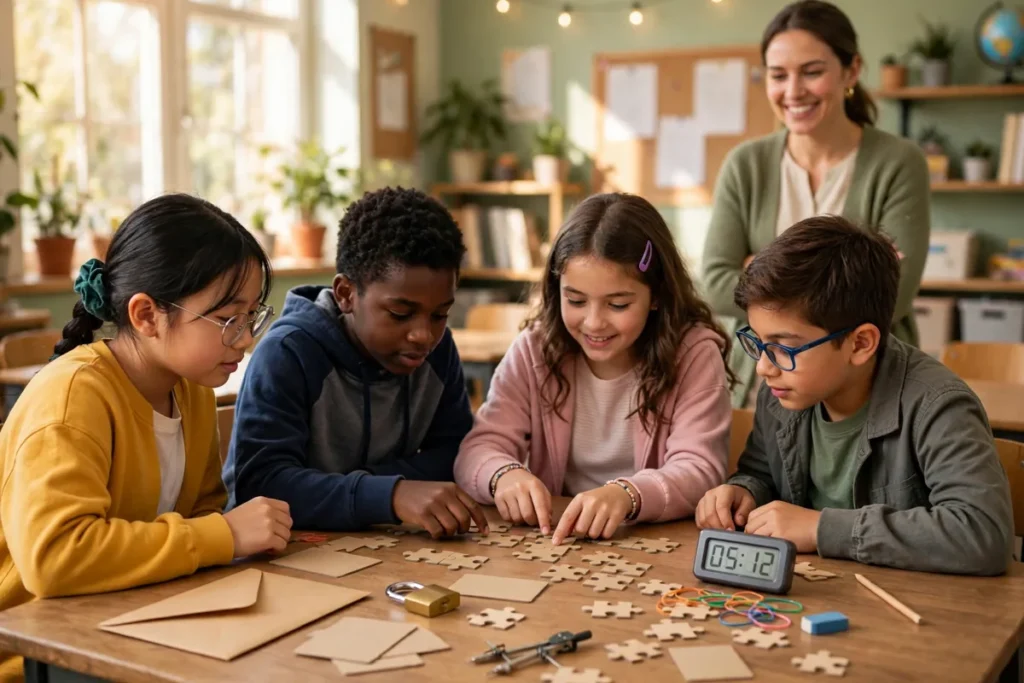
Revision lessons have a reputation problem: students know the material matters, yet another round of worksheets rarely holds their attention. Classroom escape rooms solve that problem by turning review into a story-driven challenge. Instead of answering questions in silence, small teams work through a chain of puzzles, and every correct answer unlocks the next clue. The content is the same curriculum you needed to cover anyway — only the delivery changes. This guide walks you through designing your first classroom escape room, from choosing learning goals to running the lesson and debriefing afterwards.
What Is a Classroom Escape Room?
A classroom escape room is a timed team activity built around a simple mission: solve a sequence of puzzles to “escape”, open a locked box, or complete a final task before the clock runs out. Each puzzle is tied to something students have already learned, so the game doubles as structured revision. Unlike the commercial escape rooms people pay to visit, a classroom version needs no special venue or expensive props. A few envelopes, printed clue cards and a padlock (or a digital alternative) are enough for a full lesson.
Escape rooms sit inside the wider family of game-based learning. If you are new to the concept, our beginner’s guide to what gamification is and how it works in education explains the mechanics behind points, challenges and rewards. An escape room simply packages those mechanics into one self-contained activity with a clear beginning, middle and end.
Why Escape Rooms Work for Review Lessons
The format succeeds because it changes how students relate to the material. First, it creates urgency: a visible countdown focuses attention in a way that open-ended revision rarely does. Second, it forces retrieval. To open the next lock, learners must recall facts, apply formulas or interpret evidence — exactly the active recall that makes revision stick. Third, it is social. Teams argue, explain and correct each other, and those peer explanations are often where the deepest understanding forms.
Research on game-based approaches consistently links them with higher participation, and our overview of how gamification enhances student engagement and retention explores that evidence in more detail. Escape rooms add one more advantage: they are naturally differentiated. Confident students race ahead on hard clues while quieter classmates often shine on observation or pattern puzzles that others rush past.
Step 1: Start With the Learning Goals, Not the Puzzles
The most common design mistake is picking fun puzzles first and bolting the content on afterwards. Work the other way round. Choose three to five key ideas from the unit you are reviewing — the concepts students most need to consolidate before a test or the next topic. Write them down as questions a successful team must be able to answer. Every puzzle you design must test one of those questions; if a clue is entertaining but tests nothing on your list, cut it or rewrite it.
This discipline keeps the activity honest. It also makes assessment easy: as you circulate during the lesson, you can see exactly which puzzle stalls each team, which tells you precisely which idea needs reteaching.
Step 2: Build a Simple Story and a Final Goal
A thin layer of story transforms a worksheet chain into an adventure. The narrative does not need to be elaborate — a locked treasure chest, a mad scientist’s lab, a museum heist or a spaceship control room all work. What matters is a clear final goal: open the box, reveal the code word, or “save” something before time expires. Announce the mission at the start, keep a timer visible, and let the story frame each clue (“The captain’s log is hidden somewhere in this room…”).
Keep the fiction age-appropriate and curriculum-friendly. History classes can escape a pharaoh’s tomb; science classes can neutralise a “virus”; language classes can decode a travel itinerary. The theme is decoration — the learning goals from step one remain the engine.
Step 3: Design a Chain of Four to Six Puzzles
For a standard lesson, four to six puzzles is the sweet spot: enough to fill 30–45 minutes, few enough that every team can finish. Vary the puzzle types so different strengths come into play:
- Code and cipher puzzles — a Caesar shift or symbol key that decodes a key term from the unit.
- Ordering tasks — sequencing events, steps of a process, or stages of an argument.
- Matching and sorting — pairing terms with definitions or classifying examples.
- Hidden information — answers concealed in a text, map, graph or image students must interpret.
- Calculation locks — a maths or science problem whose answer forms a combination.
Chain the puzzles so the output of one becomes the input of the next: the decoded word reveals where the following envelope is hidden, and so on. This chaining is what makes the activity feel like one unfolding mission rather than disconnected exercises. For more ideas on structuring playful tasks, see how digital game-based learning encourages creativity in the classroom — the same principles apply to paper-based games.
Step 4: Prepare Materials and Test the Timing
Print clue sets in team colours so materials do not get mixed up, and prepare a sealed “final lock” — a real padlock on a box containing a small reward works beautifully, but a folded answer card or a password-protected slide achieves the same effect. Digital versions are equally valid: several of the tools in our roundup of the best EdTech apps for students can host quiz-based locks and timers if you prefer screens to paper.
Before the lesson, solve the entire chain yourself and time it. Then double your time — that is roughly what a student team will need. Prepare a hint system in advance: for example, each team holds two hint cards it can spend. Hints keep struggling teams moving without you giving answers away, and the limited supply adds a satisfying strategic choice.
Step 5: Run the Lesson — Teams, Hints and Ground Rules
Groups of three to five work best: large enough for discussion, small enough that nobody can hide. State the ground rules clearly — no phones unless the puzzle requires one, clues stay in the room, and the first team to finish helps nobody else until all teams are done or time expires. Start the timer, then step back. Your job during the game is observation: note which concepts cause trouble, who leads, and who needs drawing in. Resist the urge to rescue teams too early; productive struggle is where the revision happens.
Debrief: Where the Real Learning Happens
Do not let the bell steal the debrief. Spend the final ten minutes walking through each puzzle as a class, asking teams to explain how they solved it. This is where misconceptions surface and get corrected in front of everyone. Connect the activity back to the unit: which ideas appeared, which will return in the test, and how students might revise them further. Pairing an escape lesson with a follow-up review schedule works especially well — our guide to spaced repetition and how it helps you remember more shows how to revisit the same material at expanding intervals so the gains last.
Students who want to keep improving between lessons can also apply the habits in our guide on how to get good grades in school, where active review strategies like this one are put into a wider study routine.
Common Mistakes to Avoid
Three pitfalls catch most first-time designers. The first is difficulty imbalance: one puzzle that is far harder than the rest bottlenecks every team. Solve this by play-testing and by making your hint system generous early on. The second is over-complication — if explaining the rules takes ten minutes, the design is too heavy. The third is forgetting the curriculum in the excitement: a beautiful game that reviews nothing is entertainment, not a lesson. Return to your learning-goal list at every design stage and the activity will stay honest.
Final Thoughts
Classroom escape rooms ask for an hour or two of preparation, and they repay it with the rarest commodity in revision week: genuine enthusiasm. Start small — one topic, four puzzles, a simple story — and refine from what you observe. Once your class has escaped its first room, you will have a reusable template that works for almost any subject, and students who actually ask when the next review lesson is.