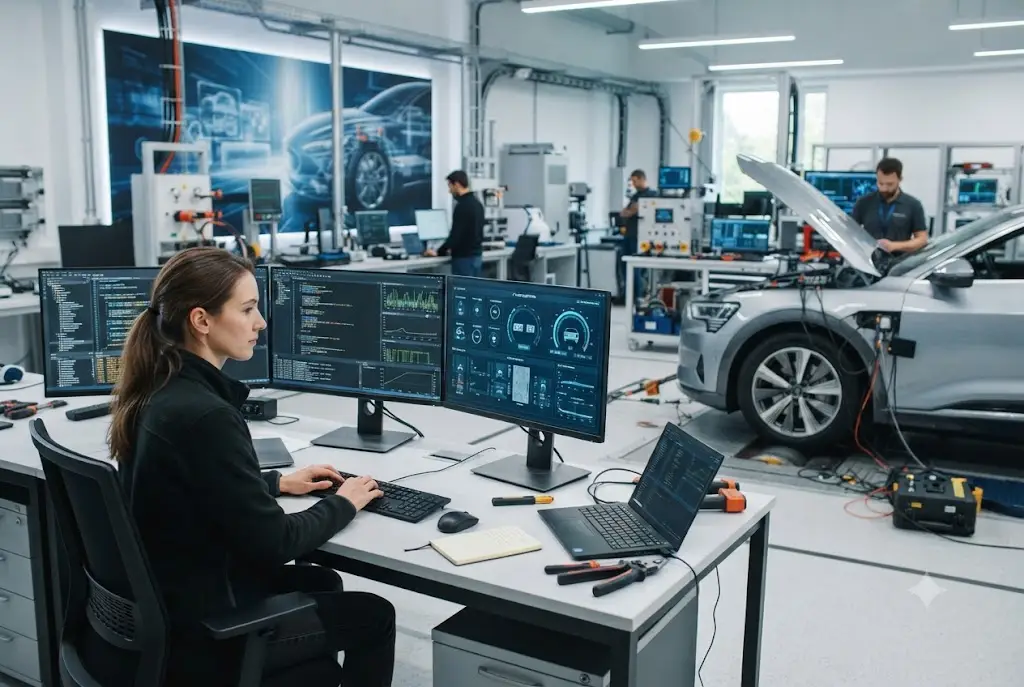
Car software development has become one of the driving forces behind today’s automotive industry. Modern vehicles rely on sophisticated software for everything from engine management and infotainment to advanced driver assistance systems (ADAS) and connected services. As cars evolve into intelligent, connected machines, software has become just as important as mechanical engineering.
Whether you’re an automotive manufacturer, software engineer, student, or technology enthusiast, understanding how vehicle software is developed provides valuable insight into the future of transportation. This guide explores the development process, key technologies, industry challenges, and emerging trends shaping software-defined vehicles.
What Is Car Software Development?
Car software development refers to the design, programming, testing, deployment, and maintenance of software systems that operate within modern vehicles. These applications control numerous electronic systems that improve safety, performance, efficiency, comfort, and connectivity.
Today’s vehicles contain dozens of Electronic Control Units (ECUs), each responsible for managing specific vehicle functions. Software allows these systems to communicate and operate together in real time.
Why Software Has Become Essential in Modern Vehicles
Automobiles have transformed from primarily mechanical machines into highly computerized platforms. Premium vehicles may include more than 100 million lines of code controlling hundreds of electronic functions.
Software enables:
- Advanced safety technologies
- Real-time navigation
- Infotainment systems
- Electric vehicle battery management
- Remote diagnostics
- Vehicle connectivity
- Autonomous driving features
- Over-the-air software updates
These capabilities improve both the driving experience and long-term vehicle maintenance.
Core Components of Car Software Development
Embedded Systems
Embedded software controls hardware components inside the vehicle. Examples include braking systems, steering, airbags, engine control, climate control, and transmission management.
Infotainment Software
Modern infotainment systems provide navigation, multimedia playback, smartphone integration, voice assistants, and internet connectivity while maintaining driver safety.
Advanced Driver Assistance Systems (ADAS)
ADAS software processes information from cameras, radar, LiDAR, and ultrasonic sensors to support features such as:
- Adaptive cruise control
- Lane keeping assistance
- Automatic emergency braking
- Blind spot monitoring
- Traffic sign recognition
- Parking assistance
Vehicle Connectivity
Connected cars exchange information with cloud services, mobile applications, and infrastructure. This enables remote vehicle monitoring, predictive maintenance, emergency services, and fleet management.
The Car Software Development Process
1. Requirements Analysis
Developers identify system objectives, regulatory requirements, safety standards, hardware limitations, and customer expectations before writing any code.
2. System Architecture
Software architects design communication between ECUs, sensors, processors, cloud services, and vehicle networks such as CAN, LIN, Ethernet, and FlexRay.
3. Software Design
Engineers create modular software components that can be updated, tested, and maintained throughout the vehicle’s lifecycle.
4. Coding
Programming languages commonly used include:
- C
- C++
- Python
- Java
- MATLAB/Simulink
- Rust (in selected modern systems)
5. Testing and Validation
Extensive testing ensures reliability under various driving conditions. Developers perform simulation, hardware-in-the-loop testing, unit testing, integration testing, and road testing.
6. Deployment
After certification, software is installed during manufacturing or delivered later using secure over-the-air (OTA) updates.
Key Technologies Driving Automotive Software
Artificial Intelligence
AI enables object detection, voice recognition, driver monitoring, predictive maintenance, and autonomous decision-making.
Machine Learning
Machine learning improves driving assistance systems by analyzing large volumes of real-world driving data.
Cloud Computing
Cloud platforms provide data storage, fleet analytics, software updates, and connected vehicle services.
Cybersecurity
As vehicles become increasingly connected, cybersecurity protects communication networks, onboard computers, and user data from unauthorized access.
OTA Updates
Manufacturers can improve performance, fix software bugs, and introduce new features without requiring dealership visits.
Automotive Software Standards
Automotive software must comply with strict international standards that ensure safety and reliability.
- ISO 26262 (Functional Safety)
- AUTOSAR Architecture
- ASPICE Process Model
- ISO/SAE 21434 (Cybersecurity)
These standards help manufacturers develop dependable software for safety-critical systems.
Challenges in Car Software Development
Building automotive software presents several unique challenges.
Safety Requirements
Even small software defects can affect vehicle safety, making rigorous validation essential.
Real-Time Performance
Many vehicle systems require instant responses measured in milliseconds.
Hardware Compatibility
Software must operate reliably across different processors, sensors, and electronic architectures.
Cybersecurity Risks
Connected vehicles require continuous monitoring to defend against evolving cyber threats.
Long Product Lifecycles
Unlike smartphones, vehicles remain on the road for many years, requiring long-term software maintenance and compatibility.
The Rise of Software-Defined Vehicles
The automotive industry is rapidly transitioning toward software-defined vehicles (SDVs), where software controls many functions traditionally managed by dedicated hardware.
This approach offers:
- Continuous feature improvements
- Personalized driving experiences
- Remote diagnostics
- Subscription-based services
- Improved vehicle longevity
Many manufacturers now view software as a core competitive advantage rather than a supporting technology.
Career Opportunities in Car Software Development
The growing demand for intelligent vehicles has created career opportunities including:
- Embedded Software Engineer
- ADAS Developer
- AUTOSAR Engineer
- Automotive Cybersecurity Specialist
- Vehicle Systems Architect
- Functional Safety Engineer
- Embedded Test Engineer
- Automotive AI Engineer
Professionals often combine expertise in software engineering, electronics, systems engineering, and automotive technologies.
The Future of Car Software Development
Emerging technologies continue to reshape automotive software. Future innovations are expected to include higher levels of autonomous driving, enhanced vehicle-to-everything (V2X) communication, more advanced AI integration, digital twins, improved battery optimization for electric vehicles, and stronger cybersecurity frameworks.
Manufacturers are also investing heavily in next-generation sports car platforms and intelligent vehicle architectures. Future articles in this automotive technology series will explore topics such as Toyota’s evolving performance vehicle engineering and new sports car platform developments to provide a broader understanding of innovation across the automotive sector.
Conclusion
Car software development is revolutionizing the automotive industry by making vehicles safer, smarter, more connected, and increasingly autonomous. As software becomes central to vehicle innovation, manufacturers continue investing in intelligent systems that improve performance, efficiency, and user experience.
For developers, businesses, and automotive enthusiasts alike, understanding this rapidly evolving field offers valuable insight into the future of transportation and the next generation of mobility solutions.
To learn more about automotive safety and vehicle technologies, visit the National Highway Traffic Safety Administration (NHTSA).
You may also enjoy our upcoming articles on Toyota Mazda sports car development and Toyota is developing a new mid-engine sports car platform for deeper insights into future automotive innovation.